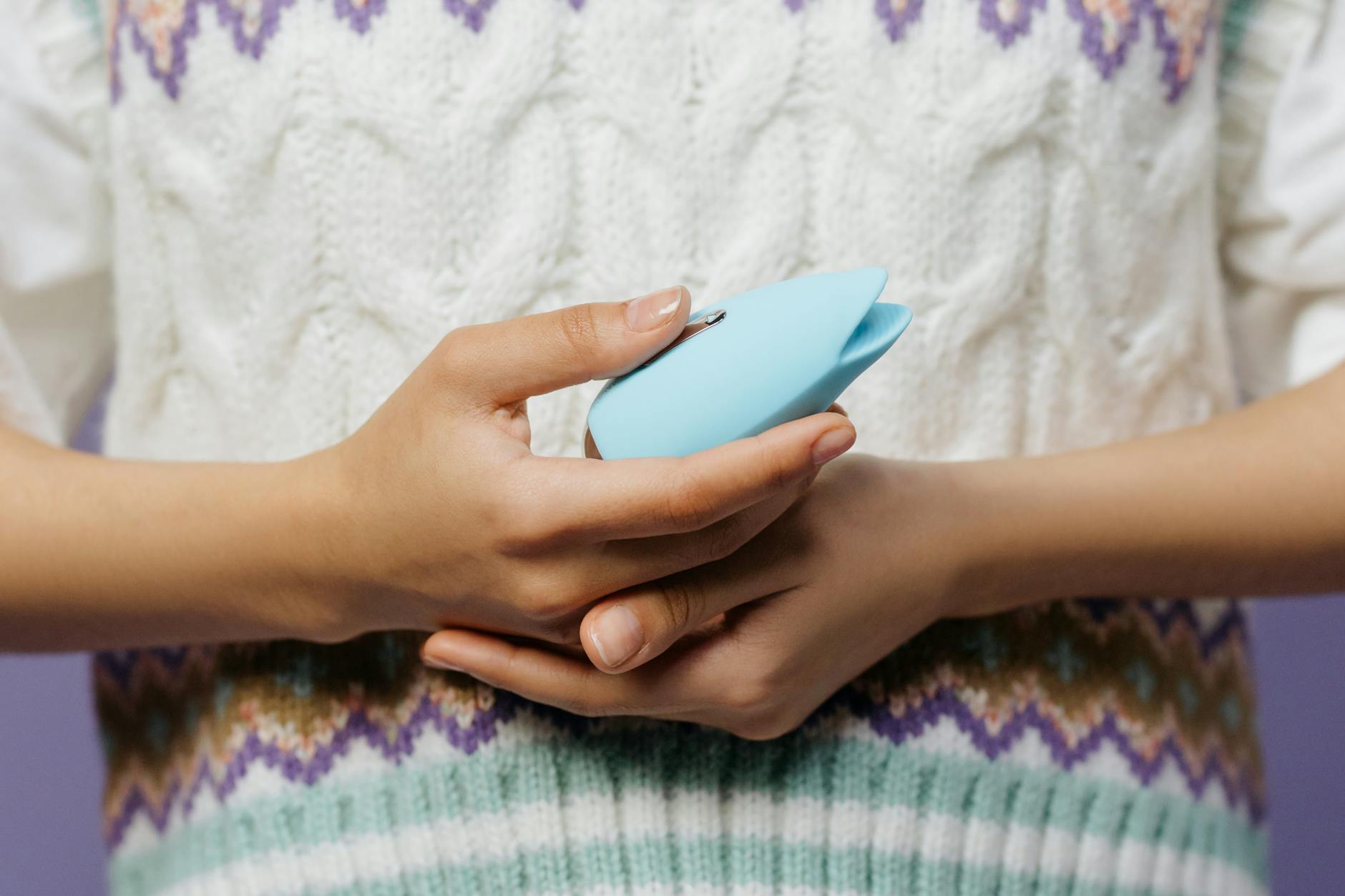
Why Lemon Vibrators Feel Different for Partners Versus Solo Use
The same lemon clitoral vibrator produces wildly different sensations when you're with someone else. Here's what changes neurologically, psychologically, and how to get the best from both.
Here's what I hear in my practice constantly: "My vibrator feels completely different when my partner is here." Sometimes it feels better. Sometimes it feels muted. Almost always, it feels different. And almost nobody knows why.
When you're alone with a lemon vibrator, your brain is running one show: pleasure-seeking. Your prefrontal cortex (the part that overthinks) dims. Your amygdala (which processes emotion and threat) relaxes. Your dopamine and oxytocin start climbing steadily.
When a partner is present, your brain is running two shows at once. Yes, pleasure-seeking is still there. But now you're also processing: their breathing, their eye contact, their approval, whether they're enjoying watching, whether you're taking too long, what they think about your body right now. Even if you trust them completely, these micro-thoughts are happening in the background.
Your sympathetic nervous system partially activates. This isn't bad. It's just different. Higher arousal, yes. But also more activation overall. The sensation of the lemon vibrator gets filtered through a different neurological state.
Most people report that lemon sexual toys feel more intense with a partner present. This has nothing to do with the vibrator itself. Same motor, same intensity settings, same pattern. What's different is arousal baseline and psychological input.
When someone you're attracted to is watching or participating, your body fast-tracks into higher arousal faster. You start at a higher baseline. This means the same vibration patterns register as more stimulating because you're already more stimulated.
But here's the counterintuitive part: some people report less intensity. Why? Because performance anxiety hijacks the parasympathetic nervous system. You're focusing on being watched, on how you look, on timing, on whether you'll come quickly enough or take too long. That mental load dilutes sensation.
Solo use: Your brain is private property. You can orbit around the edge of orgasm for 20 minutes without pressure. You can stop. You can switch patterns. You can be exactly as responsive as you actually are in that moment.
Partner use: Your brain is now processing social feedback in real time. A partner's enthusiasm or the sound of their pleasure triggers additional dopamine. But their silence or distraction can suppress it. You're now performing pleasure slightly, even if the love is real.
Oxytocin is the bonding hormone. It floods during skin-to-skin contact, eye contact, and during orgasm. When a partner is involved, oxytocin is already elevated before penetration or vibration even starts.
Oxytocin does something interesting with sensation: it softens edges. It makes things feel more diffuse, more full-body, less sharply clitoral. This is why many people describe partnered orgasms as "deeper" or "fuller" even if they're less intense in the localized sense.
The lemon vibrator is delivering the same clitoral stimulation. But the neurochemical context makes it feel different. More relational. Less mechanical. Same device, different emotional bandwidth.
If you've noticed that your lemon clitoral vibrator feels duller when your partner is in the room, this is usually one of three things:
Performance pressure. You're subconsciously modulating your response because you're aware you're being observed. Your body tenses slightly. Your breathing becomes shallower. The pelvic floor tightens instead of relaxing. All of this mutes sensation.
Distraction. Your partner's presence, even beloved, competes for your attention. Part of your neural bandwidth is on them, not on the sensation. This is especially true if you're newer to using vibrators in partnered contexts.
Mis-matched desire timing. You might want to use the vibrator at 60% arousal when alone, but your partner initiates at 30%. You're using the same lemon adult toy, but your nervous system is in a lower baseline state. Of course it feels different.
I work with couples where one partner loves the vibrator solo but feels awkward using it partnered. The other partner assumes rejection. Neither is true. The nervous system is just in a different state.
What helps: talking about it as neurology, not emotion. "When we use the vibrator together, I need longer to warm up" is a statement of fact, not a referendum on desire. "I actually come harder when you're watching, even though it takes longer to build" is useful information.
Many of my clients find that the solution is blended. Solo time with the lemon vibrator to climax. Partner time for the bonding and intimacy that oxytocin brings. Neither replaces the other.
If you want to feel similar intensity solo versus partnered, try these:
Extend foreplay. Get to a higher arousal baseline before the vibrator comes out. This narrows the gap between your solo state and your partnered state.
Lower the pressure. Literally and figuratively. Tell your partner you might need more time or a different pattern when they're present. Remove the silent expectation that you'll respond the same way.
Stay in your body. During partnered use, practice anchoring attention back to sensation when you notice it drifting to performance. It's a skill, not a failure.
Use eye contact strategically. If you find it distracting, don't. If it heightens arousal, lean into it. There's no right way.
Honestly? Both. Solo use teaches you exactly what turns you on without external input. It's research. It's your baseline.
Partnered use teaches you what pleasure feels like in connection. Often deeper, sometimes less sharp. Both are valid, and both are worth pursuing.
I have clients who use their lemon clitoral vibrator solo 80% of the time because that's where they climax most reliably. They use it partnered 20% of the time because the oxytocin hit is worth it even if the orgasm is less intense. Others flip it. There's no prescription.
The same vibrator isn't the same vibrator when someone you love is in the room. That's not a problem to solve. It's a feature to understand.
Your brain is split between sensation and social awareness. This creates a kind of gentle distraction that mutes the sharp, localized intensity you feel solo. You're processing their presence simultaneously with the vibration, which divides your available mental bandwidth for pleasure. The solution is usually longer foreplay to reach higher baseline arousal before the vibrator enters, or agreement that partnered use will naturally feel different and that's okay.
Partially. You can reduce performance anxiety through communication (knowing your partner isn't silently judging helps tremendously). You can extend foreplay to match your solo arousal baseline. You can practice staying in your body when you notice your attention drifting. But the neurochemical reality is that partnered sex activates different pathways than solo sex. The goal isn't sameness. It's learning what each context offers and choosing accordingly.
Completely normal. Many people come more reliably solo because there's zero performance pressure and 100% attention on sensation. Partnered use can feel good in a different way (more bonding, more emotional) without matching the physical intensity. Both preferences are valid, and many people enjoy both for different reasons.
Only if you frame it that way. If you present it as "I want to explore pleasure together" instead of "I need this because you're not enough," most partners respond with curiosity. The narrative matters. In my practice, couples who use vibrators together report higher intimacy, not lower, because there's honesty and shared exploration.
Oxytocin and dopamine. When your partner shows genuine interest or pleasure in your pleasure, your brain rewards that with more neurotransmitters. You're getting dual input: physical stimulation from the vibrator plus emotional reward from their presence. Conversely, if a partner seems bored or distracted, your brain picks that up and dampens the dopamine response. This is relational biology, not neediness.
Yes and no. The device is identical, but your nervous system state is different, which changes how you experience it. Many people find they need slightly different intensity settings or patterns partnered versus solo. Some discover that partnered use actually enhances sensation because oxytocin makes the full-body experience more pronounced. Experiment together and notice what works.
Your lemon vibrator isn't the variable. Your nervous system state is. Alone, you're in a private, focused, performance-free zone. With a partner, you're in a shared, socially aware, slightly higher-activation state. Both are correct. Both have their own rewards.
The best couples I work with aren't chasing sameness. They're chasing honesty about what feels good where, and they use that information to build pleasure that works for both of them. Your lemon adult toy is just a tool. The real work is communication.
Want to explore this more in your own relationship? We can help. Visit /contact to book a session or send a question.
Komisaruk, B. R., & Whipple, B. (2005). Functional MRI of the brain during orgasm in women with complete spinal cord injury. Progress in Brain Research, 152, 127-139.
Safron, A. (2016). What is orgasm? A model-based analysis of sexual pleasure and its relationship to mate selection. Socioaffective Neuroscience & Psychology, 6(31382).
Carter, C. S. (2014). Oxytocin pathways and the evolution of human behavior. Annual Review of Neuroscience, 37, 17-40.
van Anders, S. M., & Watson, N. V. (2006). Social neuroendocrinology: An evolutionary perspective on the mechanisms of human bonding. Hormones and Behavior, 49(3), 267-276.